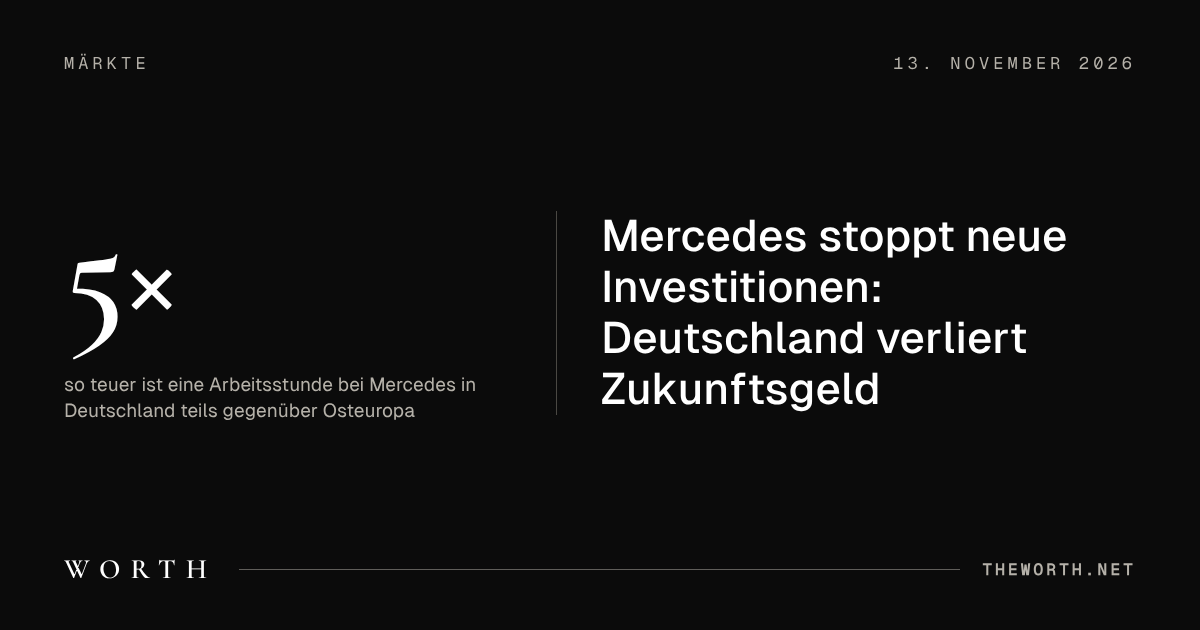
Mercedes halts new investment: Germany loses its future capital
Mercedes-Benz is suspending new investment in its German plants and weighing closures. Roche, Eli Lilly and Boehringer Ingelheim had already shelved or cut their German plans.
Two key industries, cars and pharmaceuticals, have frozen capital for German sites within weeks, both citing costs and policy. What is not invested today will be missing as factories, labs and jobs in three to five years.
What happened
On 12 November Mercedes's production chief, Michael Schiebe, said in an interview on the company intranet that the board had decided to stop all further investment in German sites. Talks on labour costs have stalled; the company says an hour of German production labour costs up to five times as much as in eastern Europe. HR chief Britta Seeger said plant closures were an option that now had to be pursued more concretely; Mr Schiebe had earlier called two plants, one assembly and one powertrain site, at risk without naming them. The chief executive, Ola Källenius, rejected a 'rotten compromise' but signalled willingness to talk.
In pharmaceuticals the same move has been under way since the summer. According to Handelsblatt, Eli Lilly is halving a planned investment of about €2.3bn in Alzey, where about 500 rather than 1,000 jobs are now expected. Boehringer Ingelheim is cutting €900m of planned German spending for 2027-30. In October Roche suspended all future investment decisions for Germany; Pfizer is reviewing its plans. The firms point to the government's health-care savings, above all a higher manufacturer rebate.
Analysis: the freezes are also leverage, against IG Metall and works councils at Mercedes and against the government in pharma, so they are not final. The signal stands: capital is turning away from German sites within weeks, while plants in eastern Europe, America and Asia still win commitments.
What follows
Suppliers, machine builders and service firms around the plants lose visibility as orders for new lines, retrofits and automation slip. Regions with Mercedes plants such as Sindelfingen, Rastatt, Bremen, Untertürkheim, Kamenz and Kölleda face more pressure. In pharma a precedent emerges: the location becomes a bargaining chip against legislation. Meanwhile Infineon shows that money still flows into Germany where AI demand is, for example in power technology for data centres.
What changes in practice
- Suppliers and plant builders
- Projects for German Mercedes plants may slip; check liquidity and order books for that case.
- Workers at car and pharma plants
- Investment freezes often precede job cuts by years. Skills in automation, data and AI raise one's market value.
- Municipalities and regions
- Business tax and new sites depend on decisions now being taken at head offices.
- Investors
- Location costs become a balance-sheet issue as groups shift capital to cheaper countries.
What to watch
- Next round of talks between Mercedes and employee representatives
- Whether other carmakers or suppliers announce similar freezes
- Changes to the health-care savings law before it is passed
Sources
- Wetterauer Zeitung (dpa): Mercedes droht mit Werksschließungen und stoppt Investitionen in Deutschland
- Investieren24: Alle Neuinvestitionen von Mercedes in deutschen Werken ausgesetzt
- Fierce Pharma: Lilly, Boehringer to slash at least $1B each from planned investments in Germany
- medinfoweb (Ärzteblatt): Sparpläne bremsen Investitionen der Pharmakonzerne in Deutschland