Insolvencies hit 16,800 jobs; nearly a third of firms plan 2027 cuts
Germany's IWH institute counted 1,683 insolvencies of partnerships and corporations in October; in an IW survey of just over 1,000 firms, almost a third expect fewer employees in 2027.
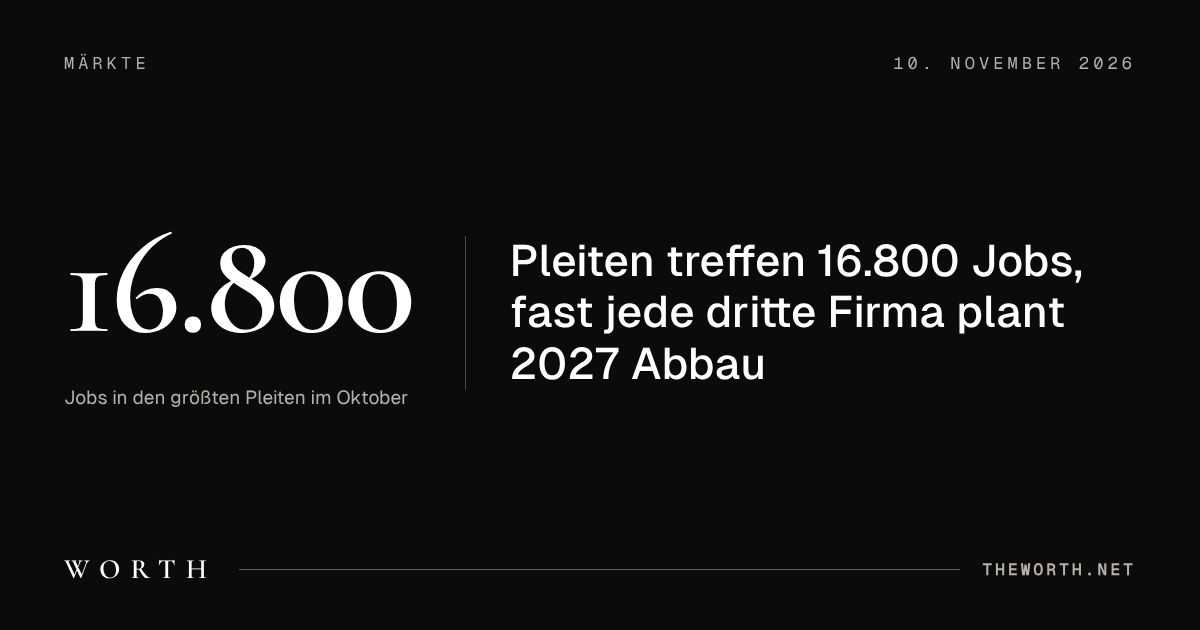
Corporate insolvencies remain high, and larger firms are now failing: the biggest 10 per cent of insolvent companies in October employed about 16,800 people, 45 per cent more than in September. The autumn survey by the IW institute shows firms planning further job cuts and lower investment for 2027.
What happened
According to the Leibniz Institute for Economic Research Halle (IWH), there were 1,683 insolvencies of partnerships and corporations in October, 1 per cent more than in September, 9 per cent more than in October 2025 and 83 per cent above the October average for 2016-19. Jobs at the largest cases rose to about 16,800, up 21 per cent on a year earlier. Manufacturing alone accounted for some 9,400, the second-highest figure since records began in 2020. In Baden-Württemberg about 6,500 manufacturing jobs were affected, a new high; Hesse recorded 180 cases, its most since 2020. Battery maker Varta was among the large proceedings. The German Economic Institute (IW), a Cologne think-tank, surveyed just over 1,000 firms in October: almost a third expect fewer staff in 2027, only a sixth more. 39 per cent plan to invest less. Michael Grömling, its head of economic research, speaks of a flash in the pan that will die out next year. So far the IW figures are available only from news-agency reports.
What follows
When jobs per insolvency rise while the number of cases stagnates, risk shifts from small businesses to industrial firms with supply chains and bank loans. For regional banks and savings banks in Baden-Württemberg and Hesse that means more provisions on commercial loans; for suppliers, more defaults among customers. With 39 per cent of firms planning to invest less, demand for new credit will also weaken. Assessment: the IWH sees a glimmer of hope. Its leading indicators have fallen and point to fewer insolvencies in November and December. A drop in case numbers would only be an all-clear if the number of affected jobs falls as well.
What changes in practice
- Manufacturing workers
- In October about 9,400 manufacturing jobs were tied to large insolvencies, especially in Baden-Württemberg.
- Banks and savings banks
- Larger insolvencies hit commercial loans harder; regional lenders in southern Germany and Hesse are most exposed.
- Suppliers and mid-sized firms
- When customers fail, payments stall; at the same time 39 per cent of firms plan to invest less in 2027.
What to watch
- The IWH insolvency trend for November in early December, especially jobs at large insolvencies
- Official insolvency statistics from Destatis, the federal statistics office, published with a lag of about two months
- Loan-loss provisions for commercial lending in regional banks' annual results
Sources
- IWH: IWH-Insolvenztrend: Firmenpleiten verharren im Oktober auf hohem Niveau, Lichtblick zum Jahresende, 5.11.2026
- cash.ch (AWP): IWH: Mehr Jobs von großen Firmenpleiten in Deutschland betroffen, 5.11.2026
- finanznachrichten.de (dts): IW-Umfrage: Fast jedes dritte Unternehmen will Stellen streichen, 10.11.2026
- retail-news.de: Insolvenzen steigen im Oktober leicht, deutlich mehr Jobs betroffen, 10.11.2026