Banks shut out AI agents, and customers who use them carry the risk
JPMorgan, Citigroup, Schwab and several big Canadian banks are blocking third-party AI agents from online banking; from 24 November Wells Fargo allows them only at customers' own risk.
North America's big banks are drawing a line: personal AI agents are not to move money using customers' log-in details. Where they are tolerated, new contract terms shift the risk onto the customer.
What happened
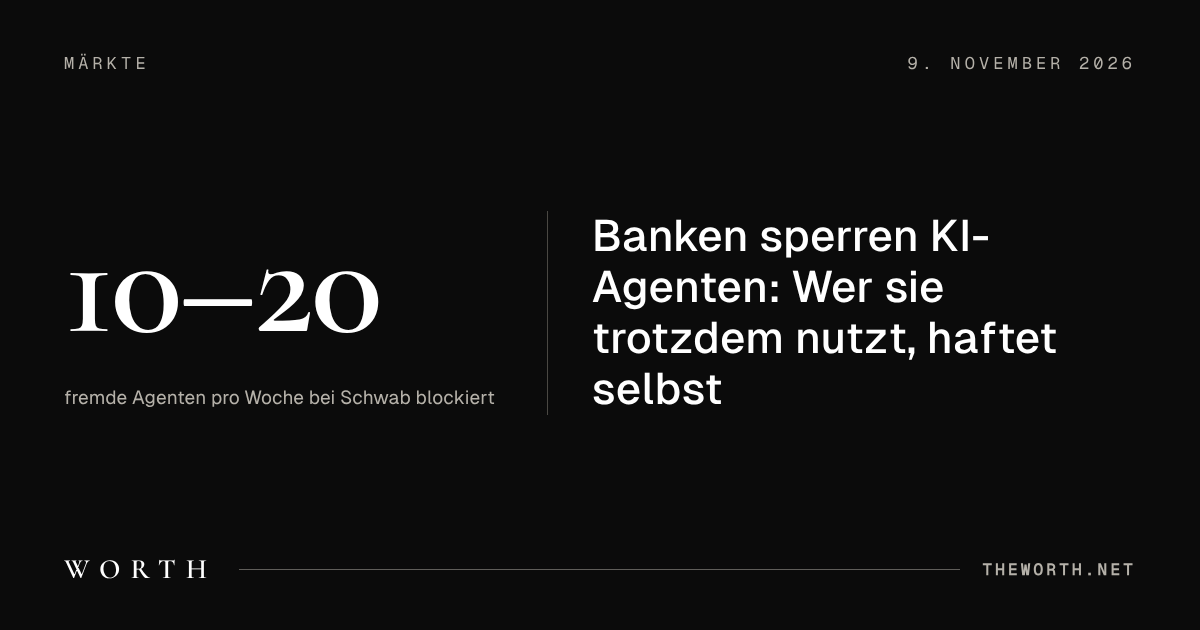
The trigger was the launch of personal agents such as Meta's Muse, which can log in to online banking with a customer's credentials. Jamie Dimon, JPMorgan's boss, said on 13 October that outside agents would not act inside customer accounts; a new user agreement taking effect on 1 January 2027 treats an agent's actions as the customer's own. Citigroup does not let third-party agents log in or transact. Schwab blocks unauthorised agents trying to move client money 10 to 20 times a week, according to its chief executive, Rick Wurster. Wells Fargo has taken a different route: from 24 November agent use is at the customer's risk, agent-initiated transactions count as authorised and the bank disclaims any duty to monitor them. In Canada, RBC, TD, CIBC and Scotiabank have blocked or restricted agents, according to CBC and MobileSyrup. The core problem is that an agent holding a password looks to the bank exactly like the customer and leaves no separate audit trail.
What follows
The result is a liability gap that opens before the rules exist. Bill Demchak, PNC's chief executive, said on 6 November that the industry was years away from letting agents move money because the liability framework was not in place. America's open-banking rule (Section 1033) remains in limbo after a court injunction. Customers who hand a password to an agent breach many banks' terms and risk losing fraud reimbursement. For now the winners are identity-verification firms: Socure, which says it works with 19 of the 20 largest American banks, expects about six months before firm agent protocols emerge. Assessment: in Europe the question is open. The Payment Services Directive governs third-party access through licensed interfaces; whether personal agents fall under it has yet to be settled.
What changes in practice
- Bank customers
- Handing log-in details to an AI agent often breaches the terms and can forfeit fraud reimbursement.
- Fintechs and AI providers
- The password route into accounts is closing; interfaces and verification for agents are what is needed.
- Banks
- They must decide whether an agent counts as the customer. Contract terms shift risk, but do not solve fraud.
What to watch
- Whether more banks adopt terms on the Wells Fargo model
- First guidance from the Fed or the CFPB on liability for agent payments
- Statements by the EBA or Germany's financial regulator, BaFin, on personal AI agents in online banking
Sources
- National Law Review (Hunton Andrews Kurth): Major Banks Move to Block or Limit Customer-Directed AI Agents, 4.11.2026
- Banking Dive: AI protocols fuel 'code red' at big banks, 6.11.2026
- eSecurity Planet: Major US Banks Move to Block AI Agents, 23.10.2026
- MobileSyrup: Canadian banks blocking AI agents, 2.11.2026