Bitcoin mining gets dearer: difficulty up 12% in four weeks
After the adjustment on 29 October, mining difficulty stands at 148.4 trillion, 2.6 per cent below its level in mid-November 2025.
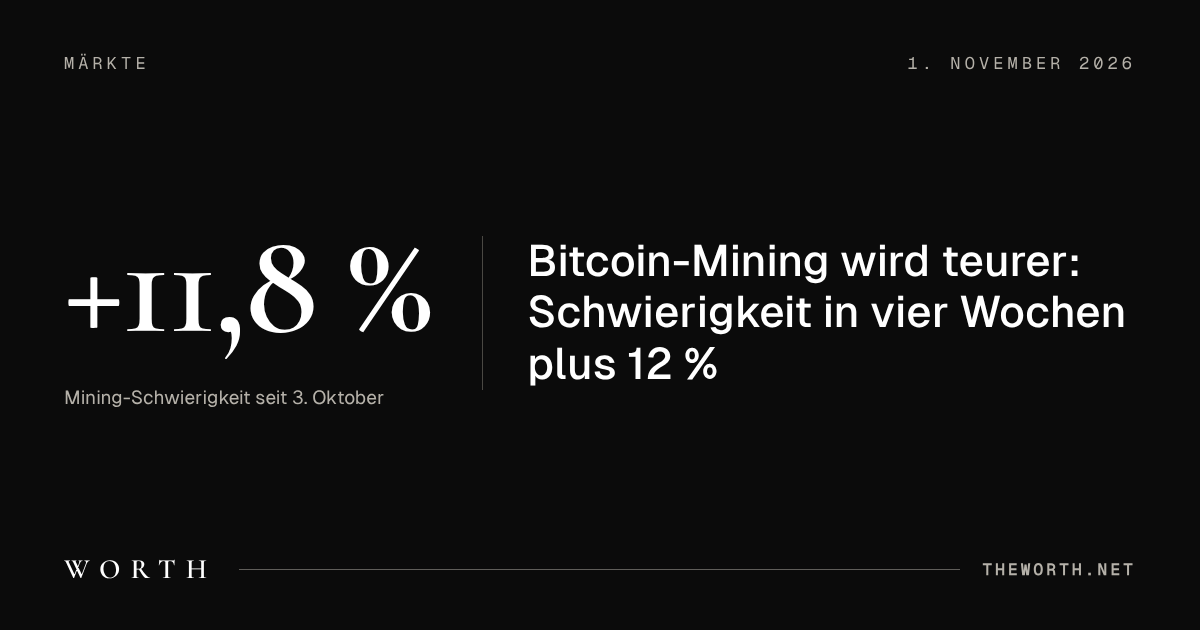
At block 973,728 on 29 October difficulty rose by 5.5 per cent to 148.4 trillion, after 5.9 per cent on 16 October, a combined 11.8 per cent since 3 October. It is the highest level since late November 2025, when difficulty stood at 149.3 trillion.
What happened
Facts: difficulty is recalculated from the blockchain every 2,016 blocks and tracks the computing power deployed. Since the low of 23 August (125.8 trillion) it has risen by 17.9 per cent. According to TokenPost, computing power most recently stood at about 1,065 exahashes per second, and this was the 11th increase in 22 adjustments this year; for the next one, around 11 November, the outlet expects a fall of 3.5 per cent. Assessment: although listed miners are handing capacity to AI customers, more computing power is returning to the network.
What changes in practice
- Miners
- Each unit of computing power earns fewer bitcoin. Operators with expensive electricity earn less per kilowatt hour as difficulty rises.
- Energy and sites
- More computing power is joining the network even as miners hand capacity to AI customers. Mining remains a rival for cheap power.
- Bitcoin holders
- More computing power makes an attack on the network more expensive. According to TokenPost it stands at about 1,065 exahashes per second.
Sources
- mempool.space: Schwierigkeitsanpassungen, 1 Jahr (Blockchain-Daten)
- mempool.space: Rechenleistung und Schwierigkeit, 3 Monate
- TokenPost: Bitcoin mining difficulty rises 5.54% in 11th upward adjustment of 2026