China's AI shares fall 40%: valuations without demand do not hold
Shanghai's STAR 50 technology index has lost about 40 per cent and some $480bn in market value in under four months; traders cite high valuations, tax bills and threatened American bans.
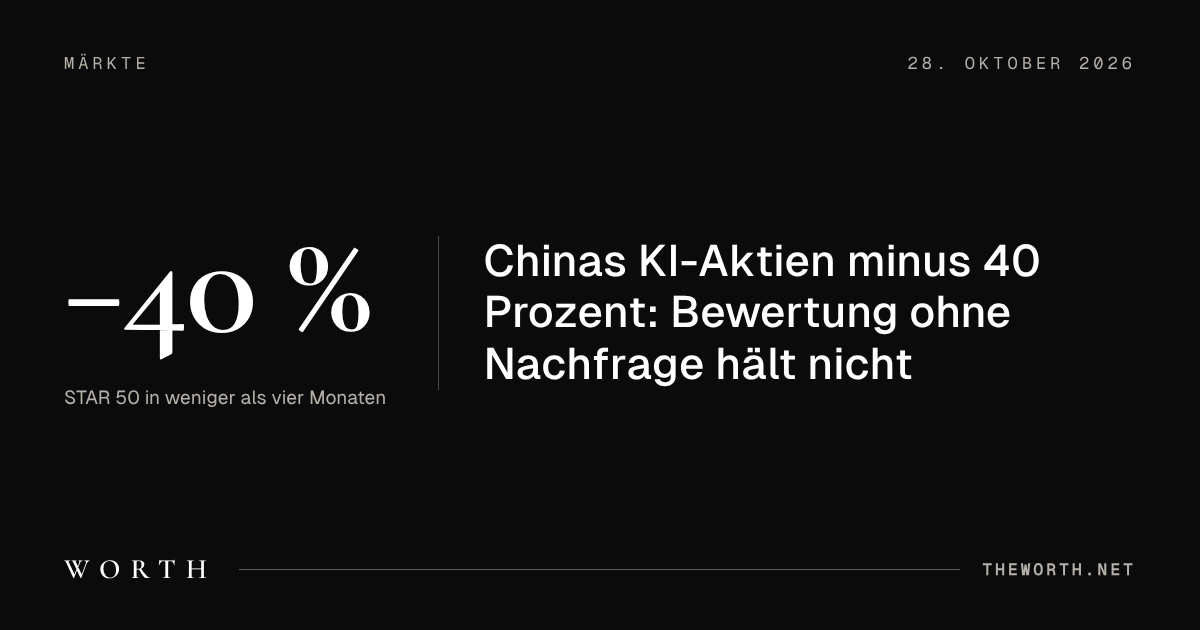
The STAR 50 index, made up mainly of Chinese AI and semiconductor stocks, has fallen by 40 per cent in under four months, erasing about $480bn of market value, according to Reuters. The broader CSI 300 is about 20 per cent below its June peak, the Nasdaq about 6 per cent below its record of early October.
What happened
China's AI boom was a policy choice: Beijing steered capital into chips, robotics and data centres, and retail investors followed. According to Goldman Sachs, AI stocks account for 42 per cent of market capitalisation and 57 per cent of turnover on mainland and Hong Kong exchanges. The fall is correspondingly broad. Unitree, a robot maker whose August listing was 8,000 times oversubscribed by retail investors, has roughly halved since. The chip designers MetaX and Moore Threads have each lost about half their value since July; the optical suppliers Zhongji Innolight and Eoptolink are down some 60 per cent from their peaks as Washington moves towards barring them from supplying American data centres. There is no single trigger. High valuations, tax bills, weak consumer demand, disappointing margins and the threat of bans abroad are all cited. Even after the fall, the STAR 50 trades at about 100 times trailing earnings, down from a peak near 250; the Nasdaq 100 trades at about 30. Beijing has curbed leveraged and high-frequency trading.
What follows
Assessment: the episode shows what happens when industrial policy channels capital faster than customers create demand. Humanoid robots in China are bought mainly by government agencies and research institutes; for consumers they remain too expensive. If the stockmarket ceases to be a source of funds, financing for young chip and robotics firms tightens. Hong Hao, a fund manager, expects many planned listings to be called off; another investor predicts a price war among chipmakers and AI suppliers. Should one begin, Chinese components could become cheaper for European industrial buyers and European suppliers would face greater price pressure. For Western AI markets the fall is no proof of a bubble, but it shows how quickly high valuations can drop when earnings fail to materialise. It comes as Anthropic and Meta seek to raise billions on the stockmarket.
What changes in practice
- Investors in China funds
- Because AI stocks make up about 42 per cent of market value in China and Hong Kong, the fall also hits broadly diversified China funds.
- Industrial buyers
- If a price war breaks out among Chinese chip and AI suppliers, components get cheaper and European competitors come under pressure.
- Young tech firms in China
- The stockmarket as a source of capital narrows; fund managers expect planned listings to fall through.
What to watch
- Purchases by state-linked funds and insurers in Chinese equities
- Washington's decision on bans for Chinese data-centre components
- Number of cancelled or postponed listings on the STAR Market
Sources
- Reuters via Kathmandu Post: In China, the AI bubble has already burst (27.10.2026)
- Geo News: AI bubble bursts in China as STAR50 Index plunges 40%, erasing $480 billion (26.10.2026)
- Newsmax via Yahoo Finance: China's STAR 50 Index Plunges 40% as AI Profit Hopes Fade (27.10.2026)