BSI counts 75,400 infected devices a day as flaws are hit in days
Germany's Federal Office for Information Security (BSI) has raised its assessment to 'tense to critical'. About 75,400 infected systems in Germany are reported each day, 89 per cent more than a year earlier.
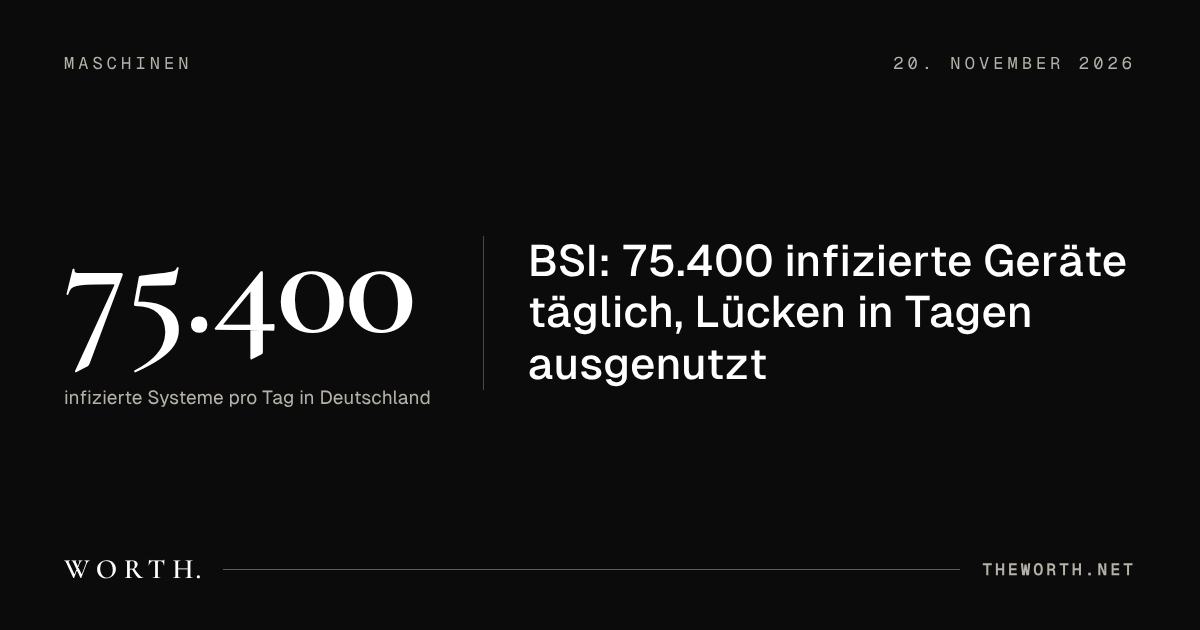
The BSI is using its own index for the first time, and it stands 50 per cent above the previous period on average. The drivers are cheap connected devices and AI, which finds weaknesses faster than many firms can close them.
What happened
The annual report, presented in Berlin on Thursday by BSI president Claudia Plattner and interior minister Alexander Dobrindt, is the authoritative stocktake for Germany. The new BSI Cyber Index (2024 = 100) averaged 170 points in the reporting period and reached 238 in the second quarter of 2026. The agency cites larger attack surfaces from connected devices and AI (up 117 per cent) and more attacks (up 48 per cent). Of the infected systems reported daily, 88 per cent are Android devices, mostly TV boxes and media players, some carrying malware from the factory. Criminals rent them out as networks of disguised addresses. The average time between a flaw becoming known and its exploitation was most recently eight days; reports differ on the comparison figure for the previous period. Ms Plattner says AI uncovers weaknesses that went unnoticed for up to 20 years and expects attacks by autonomous AI agents to be the next stage. Assessment: the report does not put a figure on total losses.
What follows
For companies the bottleneck is shifting from detection to response. Firms that patch monthly are, on average, too late when attackers need eight days. Small and mid-sized firms are most exposed: according to the BSI they account for 90 per cent of reported ransomware attacks. Meanwhile 90 per cent of firms surveyed rate their security as good or very good, yet in BSI checks even security-aware businesses met only 55 per cent of minimum requirements. The gap between self-image and reality is becoming a question of liability and insurance. The state is building a central defence system, Cyberdome, but has given no completion date.
What changes in practice
- Mid-sized firms
- Small and mid-sized firms account for 90% of reported ransomware attacks, says the BSI. Even security-aware ones meet only 55% of minimum requirements on average.
- IT departments
- Flaws are now exploited after eight days on average. Monthly patch cycles often no longer suffice.
- Consumers
- Uncertified TV boxes and media players can ship with malware. Only 40% use two-factor sign-in.
What to watch
- Whether cyber insurers adjust premiums or obligations after the report
- Implementation of NIS2 duties at around 30,000 affected companies
- Timetable and scope of the state's Cyberdome defence system
Sources
- dpa-AFX via ARIVA: Alltagsgeräte im Visier – BSI warnt vor Cyberangriffen
- t-online: Neuer Bericht zur Cybersicherheit – KI befeuert Hackerangriffe
- teltarif: BSI schlägt Alarm – Alltagsgeräte im Visier