AI turns patches into attacks: slow updaters are now the target
Google's Threat Intelligence Group reported on 16 November its first case of an AI system finding and exploiting flaws without human direction; Google is deploying its own AI in response.
Attackers are letting AI agents take security updates apart, identify the flaw that was fixed and build the attack, with no human involved. The gap between patch and attack is shrinking from days to minutes, and defenders are answering with AI agents of their own.
What happened
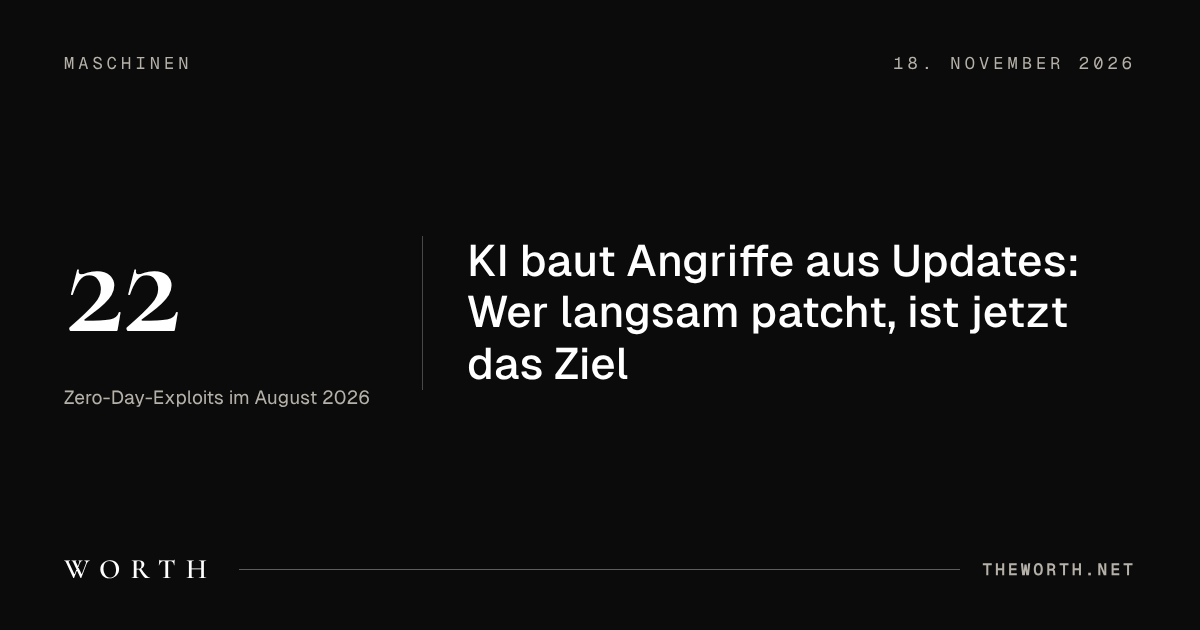
In a blog post on 16 November Google wrote that attackers now use autonomous AI frameworks to scan software updates continuously, work out which flaw was patched and build an attack for it, "without human involvement". According to TechNode, Google's Threat Intelligence Group found a system called "exploit_agent" on an exposed server: it compared code before and after patches, drafted exploits and ran them itself. Google calls it the first such case it has identified. A second actor used PentAGI, a freely available platform, from late August to early October for systematic reconnaissance against organisations in Asia. According to SecurityBrief, reported vulnerabilities and exploits almost doubled between January and August 2026; Google counted 22 zero-day exploits in August, against an average of 8 a month in 2025. In one case attackers went from first foothold to full domain control within minutes. Google's published texts do not name states or models behind the attacks.
What follows
An old certainty of IT is breaking: publishing an update protects only those who install it at once. For everyone else, the patch becomes a blueprint. John Hultquist, a Google analyst, told SecurityBrief that firms will come under enormous pressure to shorten patch cycles. Google is betting on AI against AI: its new "AI Threat Defense" combines Gemini, the platform of Wiz, the security firm it bought, and CodeMender, an automated patching tool, to find and close flaws before attackers use them. Assessment: who wins will depend less on the size of the security team than on the speed of its automation. For mid-sized firms with monthly maintenance windows, that is the real news.
What changes in practice
- IT departments
- Install critical updates in hours, not weeks; a published patch is a template for attackers.
- Managing directors
- Monthly maintenance windows no longer suffice; patch speed becomes a management and budget question.
- Developers
- Protect configuration files of AI coding assistants; Google reports attempts to plant backdoors through them.
What to watch
- Whether Germany's BSI or America's CISA shorten deadlines for critical updates
- The monthly count of zero-day exploits in Google's next report
- Insurers tying cyber policies to patch times
Sources
- Google (GTIG): Outpace automated cyber threats with security built for nonstop defense, 16.11.2026
- Google Cloud (GTIG): AI Threat Tracker report
- TechNode Global: Google finds attackers using AI agents for autonomous exploitation, 17.11.2026
- SecurityBrief: Google warns of autonomous AI attacks finding flaws, 16.11.2026