Carmakers move money and plants abroad; suppliers and regions pay
A €5.82bn quarterly loss at Volkswagen, an 87 per cent profit drop at Audi, Chinese parts at Mercedes, an Audi plant in Georgia: the week showed where the car industry's capital goes and where the costs stay.
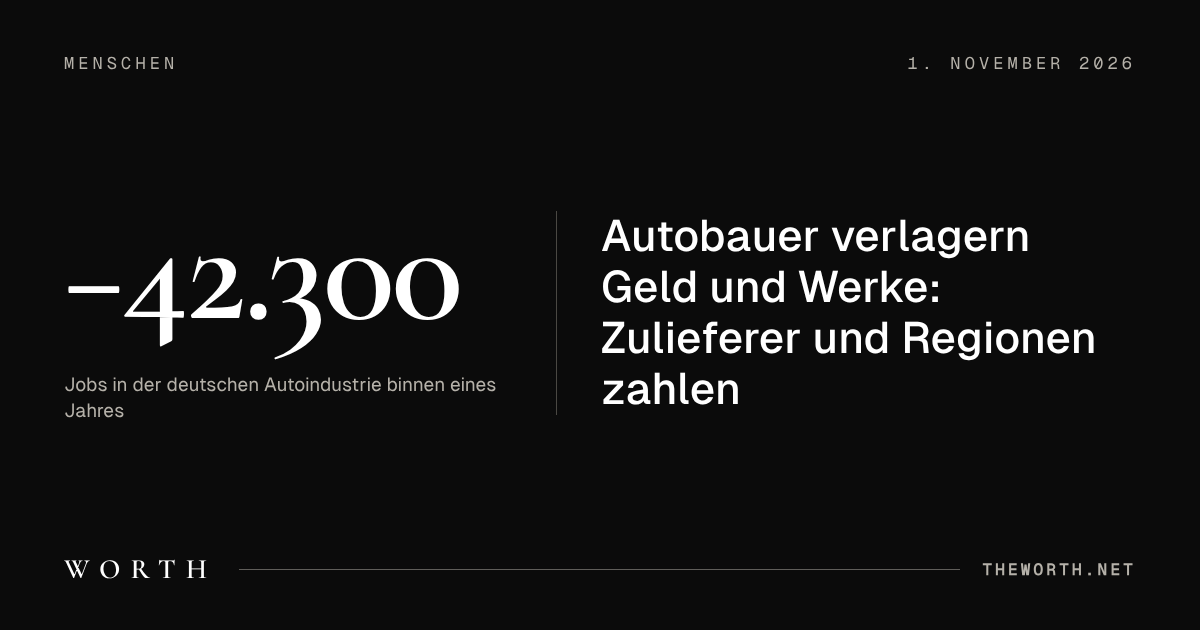
The old model of developing and building in Germany and earning in China no longer holds: this week Volkswagen, Audi and Mercedes cut their targets and redirected money to American plants and Chinese supply chains. The bill falls on workers, suppliers and sites such as Neckarsulm, Zwickau and Osnabrück, while Tesla and BYD gain market share in Germany.
The week
- 23 Oct: Volkswagen names 12,000 additional jobs to go at Volkswagen AG by 2030.
- 25 Oct: Audi announces a plant in Georgia: about $4bn, up to 4,500 jobs, production from the early 2030s.
- 27 Oct: Gesamtmetall, the employers' federation, offers a one-off payment in 2027 and a 1.3 per cent rise from July 2028; the IG Metall union wants 5 per cent.
- 28 Oct: Mercedes cuts its car-margin forecast to 2-3 per cent and plans to source almost all parts for its Chinese production locally. Ralf Brandstätter, head of VW China, sees the market "in free fall".
- 28 Oct: Playmobil's parent plans a 100-megawatt data centre at its closed plant in Dietenhofen; VW starts dismantling end-of-life cars in Zwickau.
- 29 Oct: Volkswagen reports a third-quarter net loss of €5.82bn, including a €6.4bn write-down on Porsche.
- 30 Oct: Audi earns €95m in the quarter, against €718m a year earlier, and cuts its annual targets.
- 1 Nov: The no-strike obligation in the metal and electrical industry expires; IG Metall calls warning strikes.
What happened
Volkswagen's Chinese joint ventures sold 1.22m vehicles in nine months, against 1.88m a year earlier; their contribution to operating profit swung from €744m to minus €113m. Even before special items the group's margin is 3.8 per cent, which Arno Antlitz, the finance chief, calls too low to keep investing heavily in the future. Mercedes sold 8 per cent fewer cars in the quarter, with the entire decline in China. Audi cites American tariffs as one reason for its lower forecast.
The effect is already visible in employment. According to Destatis, the federal statistics office, 691,500 people worked in the car industry at mid-year, 42,300 or 5.8 per cent fewer than a year earlier and the lowest number since 2005. Employment fell by 7.6 per cent at suppliers and 6.1 per cent at manufacturers.
Assessment: profits from China long helped pay for high costs in Germany. Without them, each site is measured one by one against America and China.
Questions
Which jobs in the car industry are most affected?
Suppliers are shrinking fastest: employment fell by 7.6 per cent in a year, according to Destatis, against 6.1 per cent at manufacturers. At Volkswagen AG, 12,000 jobs come on top of the more than 35,000 agreed in 2024. Audi is cutting up to 7,500 jobs by 2029 and has invoked a clause for Neckarsulm that permits talks on further savings. The new instrument is the transfer company: staff end their contracts and receive up to 12 months of transfer short-time allowance from the Federal Employment Agency.
Why are German carmakers building in America and buying in China?
In both cases the reasons are costs and tariffs. American tariffs cost Audi about €1.2bn in 2025, according to Reuters; its American cars have so far come mainly from Europe and Mexico. The Georgia plant is to build up to 200,000 cars a year, but only from the early 2030s. According to Handelsblatt and Tagesspiegel, VW's supervisory board has no binding commitments from the American government yet. From the electric E-Class in the second half of 2027, Mercedes plans to buy almost everything locally for its Chinese production, because more than 100 brands compete on price there. Orders that went to European suppliers will disappear.
What do the metalworkers' warning strikes from 1 November mean?
About 3.7m employees in cars, machinery and electrical engineering are covered. IG Metall wants 5 per cent for 12 months and contractual protection for sites. Gesamtmetall offers a one-off payment of 1 per cent of annual pay in July 2027 and a 1.3 per cent rise from July 2028, plus exemptions for weak firms. The south-west shows how wide that group would be: about 25 per cent of Südwestmetall's 641 member firms are loss-making, according to the regional federation, and about 20 per cent more earn a return on sales of no more than 2.3 per cent. Assessment: the dispute is less about percentages than about how many firms may pay below the agreement.
Who is winning in the German car market?
The market itself is growing: 256,774 cars were newly registered in September, according to the Federal Motor Transport Authority, 9.0 per cent more than a year earlier. The gains go mostly to others. Tesla's registrations rose by 268.7 per cent to a 4.9 per cent share, BYD's by 85.6 per cent to 2.4 per cent and MG Roewe's by 60.8 per cent. VW fell by 6.1 per cent, Porsche by 18.8 per cent and BMW by 2.4 per cent; Mercedes and Audi grew. There are German winners in electric cars too: Mercedes sold 68,000 worldwide in the third quarter, 61 per cent more.
Coming weeks
The coming weeks will show how hard the restructuring becomes. Warning strikes begin on 1 November, first in Baden-Württemberg, home to many suppliers. At Audi, management and works council are negotiating savings in Neckarsulm; closure is being discussed, according to dpa, but has not been decided. At VW the talks concern the 12,000 additional jobs and transfer companies. It is also open whether VW's supervisory board will approve the Georgia plant without binding American commitments.
One to three years
Within one to three years the effect on regions will become visible. VW wants to cut costs by about €31bn and plans to sell Volkswagen Osnabrück; four German VW and Audi sites currently have no secured vehicle production. Assessment: if orders from China and for America fall away, thinly capitalised mid-sized suppliers are hit first, and with them the savings and co-operative banks that lend to them. At the same time new businesses are appearing on old sites: VW wants to dismantle up to 15,000 end-of-life cars a year in Zwickau by 2030 and raise the jobs there from 100 to up to 1,000.
Five to ten years
In five to ten years the value of an industrial site is likely to be measured differently. At the former Playmobil plant in Dietenhofen the asset is not the hall but the 110-kilovolt line meant to supply a 100-megawatt data centre; the company names neither the investment nor the number of jobs. VW plans to export platforms, electronics and software developed in China to other regions. Assessment: part of the development work thus moves to where the volumes are. For Germany the question remains whether batteries, recycling, software and data centres will replace the jobs lost in carmaking. There is no evidence of that so far.
What changes in practice
- Supplier employees
- Their sector is shrinking fastest, down 7.6 per cent in a year. Lost orders from China and America hit them first.
- Employees at VW, Audi, Mercedes
- Cuts run through severance and transfer companies with up to 12 months of transfer short-time allowance, not dismissals.
- Regional banks and mid-sized firms
- If suppliers lose orders, credit risks rise in regions such as Heilbronn, Zwickau or Osnabrück.
- Car buyers
- The market grows, and choice becomes more Chinese and electric: Tesla and BYD rose by 268.7 and 85.6 per cent in September.
What to watch
- Outcome of the metalworkers' pay round, above all the number and terms of exemptions for weak firms
- VW's deliveries in China in the fourth quarter: fewer than 2m for the year would be the lowest since 2010
- The next Destatis employment figures for manufacturers and suppliers
Sources
- Volkswagen Group: Nine-month results underline urgent need for action (29.10.2026)
- ad-hoc-news (dts): Volkswagen meldet 5,82 Milliarden Euro Verlust im dritten Quartal
- finanzen.at (dpa-AFX): VW-China-Chef sieht Markt im freien Fall (28.10.2026)
- Mittelstand-Nachrichten (dts): VW stellt sich auf dauerhaften Einbruch in China ein
- Audi: First US production site in Georgia (25.10.2026)
- Handelsblatt: VW-Aufsichtsrat fehlen bindende Zusagen für Audis US-Deal
- Tagesspiegel: „Halten faktisch nichts in den Händen“ (29.10.2026)
- ariva: Audi veröffentlicht Ergebnisse für das dritte Quartal
- 20 Minuten: 87 Prozent weniger, Audi-Gewinn bricht ein
- Börsen-Zeitung: Schlechtwetter in Neckarsulm, Audi bereitet Stellenabbau vor
- Mercedes-Benz Group: Q3 2026 Interim Report
- Investing.com: Earnings call transcript Mercedes-Benz Q3 2026
- ariva (dpa-AFX): VW will auch über Transfergesellschaft verhandeln
- Berliner Zeitung: Audi USA-Werk und Stellenabbau in Deutschland
- Statistisches Bundesamt: Beschäftigung in der Industrie, Pressemitteilung 14.08.2026
- Clean Energy Wire: German car industry sheds 42,300 jobs
- Kraftfahrt-Bundesamt: Fahrzeugzulassungen im September 2026
- ariva (dpa-AFX): IG Metall startet Warnstreiks am Sonntag (30.10.2026)
- IG Metall: Tarifrunde Metall und Elektro
- onvista (dpa-AFX): Metall-Tarifrunde, Arbeitgeber bieten Einmalzahlung und 1,3 Prozent
- Salzburger Nachrichten (APA/dpa-AFX): Playmobil-Werk soll zu Rechenzentrum werden
- WirtschaftsWoche: VW startet Hochlauf für Auto-Demontage in Zwickau