AI debt reaches insurers: nearly 8% of long euro bonds are US tech
The ECB's Financial Stability Review of 18 November finds that US hyperscalers account for close to 8 per cent of euro investment-grade corporate bonds maturing after ten years, with insurers and pension funds modestly overweight.
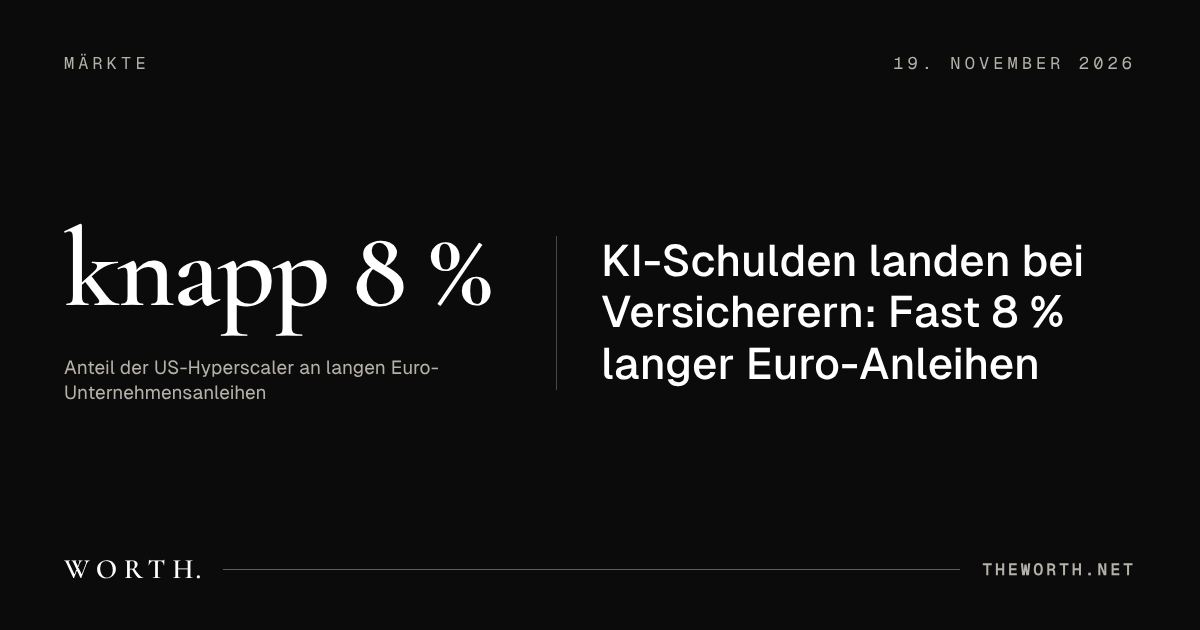
America's AI build-out is increasingly financed with debt, and a growing share of it sits with Europe's long-term investors. If AI revenues disappoint, the ECB warns, losses could spill from equities into bond markets.
What happened
AI risk has so far been treated as an equity story: high valuations concentrated in a few names. The ECB widens the lens. Investment in AI infrastructure is increasingly funded through debt, its Financial Stability Review of 18 November says. In the US dollar investment-grade market alone, the large cloud groups have raised more than $200bn this year. Their share of the euro market as a whole is still small, but among bonds maturing after ten years it reaches close to 8 per cent. US companies overall make up nearly a fifth of the euro investment-grade benchmark. Hyperscaler bonds carry maturities two to six years longer than those of comparable issuers. That long end is precisely what life insurers and pension funds buy, and the ECB finds they hold such paper modestly above benchmark weight. Long liabilities thus meet data centres and chips that lose value quickly. Assessment: the ECB considers euro area banks well placed. The risk lies less with them than with investors who promise fixed payments far into the future.
What follows
For Europe's retirement savings, whether AI pays off becomes a balance-sheet question. If revenues fall short, risk premiums rise and long bonds lose value at the same time as the same companies' shares. Diversification between equities and bonds then offers less protection, the ECB warns. A second mechanism: if a few large issuers fill the long end, other borrowers, governments included, may have to pay more for long maturities. President Christine Lagarde wrote to two MEPs in early November that the ECB so far sees no significant effect on sovereign bonds. Assessment: this is not a crisis signal but a concentration building up quietly.
What changes in practice
- Policyholders
- Life insurers and pension funds hold tech bonds modestly overweight. An AI setback would hit their investments, not only equity portfolios.
- Investors
- Shares and bonds of the same AI companies can fall together. Spreading money between the two then protects less.
- Companies
- If a few tech giants fill the long end of the euro market, long-term funding may become dearer for other firms.
What to watch
- New euro bonds from Alphabet, Amazon, Meta and Microsoft, and their maturities
- Risk premiums on long tech bonds relative to other corporates
- Cloud groups' quarterly AI revenues set against their capital spending
Sources
- EZB: Financial Stability Review, November 2026
- EZB: Big tech’s growing presence in the euro-denominated bond market (Box)
- EZB-Pressemitteilung: Risks from AI valuations, fiscal imbalances and geoeconomic tensions
- Cash.: EZB warnt vor Big-Tech-Konzentration im Euro-Anleihemarkt
- Börsen-Zeitung: Hyperscaler zapfen Euro-Bondmarkt mit Flut von Neuemissionen an