Metalworking pay talks stall; longer strikes would hit supply chains
After fruitless third rounds of talks, the IG Metall union has suspended negotiations in Baden-Württemberg; its executive meets on 11 November to consider widening the warning strikes.
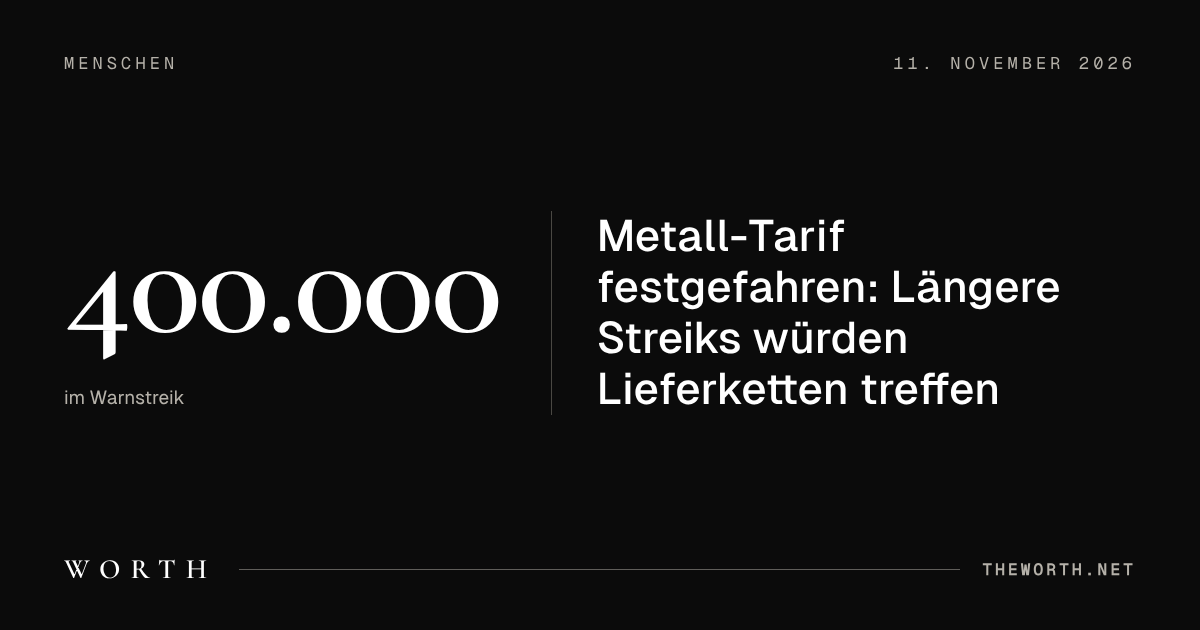
Since 1 November more than 400,000 workers have joined warning strikes, according to the union, and employers have made no new offer. If escalation is approved, longer stoppages loom in an industry already suffering from weak orders and job cuts.
What happened
In five bargaining regions the third round ended without agreement on 9 November; according to IG Metall, employers presented no improved offer. In Baden-Württemberg the union is not continuing talks on current terms for now, and several other districts have no new date. IG Metall wants 5 per cent more pay over 12 months, plus job and site guarantees, profit-sharing and a component for low earners. Employers offer a one-off payment of 1 per cent of annual pay in July 2027, which can be adjusted at plant level, and a 1.3 per cent rise from July 2028, over 26 months. They also want a plant-level instrument for investment and sites, and talks on sick leave and AI. On 9 November alone about 50,000 workers at some 140 plants struck, according to the union; in Bavaria about 36,000 from 110 plants walked out that day.
What follows
Longer or full-day strikes would hit not just individual plants but, through tightly scheduled supply chains, customers that are not on strike themselves. That adds to the strain on firms such as BMW, which recently had to cancel shifts because of missing parts. Assessment: at its core the dispute is less about percentages than about two questions of principle: how far plants may deviate from the industry-wide agreement, and whether the use of AI is regulated by collective agreement. The contrast in the same week: Infineon expects revenue growth of about 22 per cent in its new financial year, driven by AI data centres.
What changes in practice
- Employees
- Under the employers' offer, pay scales would stay unchanged until mid-2028; the union aims to prevent that through strikes.
- Companies
- Longer strikes at suppliers can halt plants that are not on strike via supply chains.
- Mid-sized firms
- A plant-level opt-out could give weak firms breathing space but widen pay gaps between plants.
What to watch
- The IG Metall executive's decision on full-day warning strikes or further steps
- New negotiating dates, especially in Baden-Württemberg as a possible pilot region
- Whether AI rules appear in a settlement
Sources
- IG Metall: Alles zur Metall-Tarifrunde 2026, Stand 10.11.2026
- All-Electronics: Metall-Tarifrunde 2026 – IG Metall berät über Eskalation, 9.11.2026
- dpa-AFX-Überblick: Unternehmen vom 10.11.2026 (IG Metall, BMW)