Office PCs get dearer as Intel sees the slump lasting into 2027
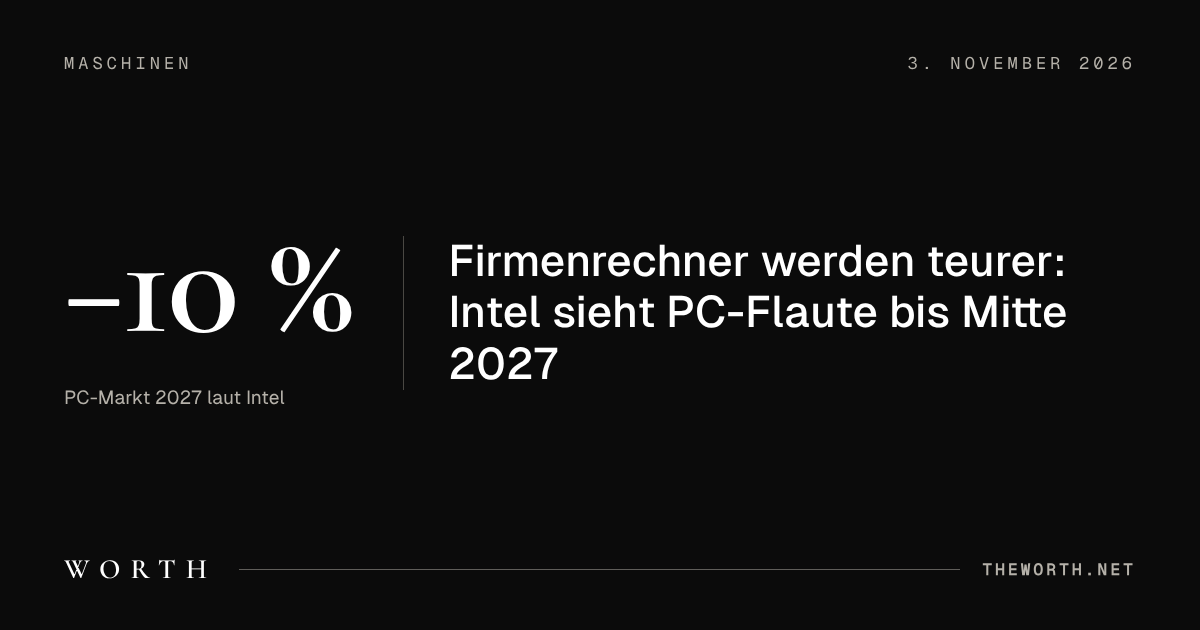
Intel issued weaker guidance for the final quarter on 29 October; its chief financial officer, David Zinsner, said the slowdown in PCs will last at least until mid-2027 because memory chips are scarce and expensive owing to demand from AI data centres.
The AI build-out is drawing away from the mass market a component no computer can run without. At Intel the data-centre business is growing by 78 per cent while the PC business shrinks.
What happened
According to its quarterly release, Intel's revenue rose by 21 per cent to $16.5bn in the third quarter. The data-centre and AI division grew by 78 per cent to $7.3bn, while the PC business fell by 5 per cent to $8.1bn. For the fourth quarter Intel expects revenue of $15bn-16bn, against analysts' forecasts of about $17bn. Mr Zinsner said the PC slowdown would continue at least through the first half of next year; in its risk factors Intel cites industry-wide shortages of memory and substrates. According to AWP, a Swiss news agency, Intel expects the PC market to shrink by a further 10 per cent in 2027 after a 12 per cent fall this year; Lip-Bu Tan, the chief executive, called memory prices a serious problem for the whole market into next year. The shares lost about a fifth in after-hours trading. Assessment: last year was inflated by the end of support for Windows 10, so part of the decline is a return to normal. The market-wide forecasts are Intel's own estimates.
What follows
For companies, the arithmetic of replacing laptops and desktops is shifting. As long as memory makers sell their capacity first to AI data-centre operators willing to pay more, unit costs for ordinary computers rise or delivery times lengthen. Smaller buyers without long-term contracts are hit first. At the same time Intel is becoming more of a supplier to AI data centres, whose processors themselves drive demand for memory. Assessment: the shortage is not a short-lived event. SK Hynix said on 29 October that memory chips would remain scarce until 2030.
What changes in practice
- Companies
- Firms planning to replace laptops and desktops in 2027 face higher prices as long as memory goes first to AI data centres.
- IT departments
- Keeping existing devices longer becomes more likely; Intel sees no PC recovery before the second half of 2027.
- Investors
- At Intel, $7.3bn of data-centre and AI revenue now stands against $8.1bn from PCs; the gap is closing fast.
What to watch
- Price lists from Dell, HP and Lenovo for business customers
- Memory prices in the next results from Samsung and Micron
- Intel's fourth-quarter report at the end of January
Sources
- Intel: Intel Reports Third-Quarter 2026 Financial Results
- SEC EDGAR: Intel Form 8-K, Q3 2026 earnings release
- cash.ch (AWP): Intel enttäuscht mit Prognose, Aktie bricht nachbörslich ein
- Shacknews: Intel CFO expects PC demand to weaken