AI is not cutting jobs so much as preventing new ones
Data from the US Federal Reserve and Germany's IAB point the same way: so far AI works through hiring that never happens, and the young feel it first.
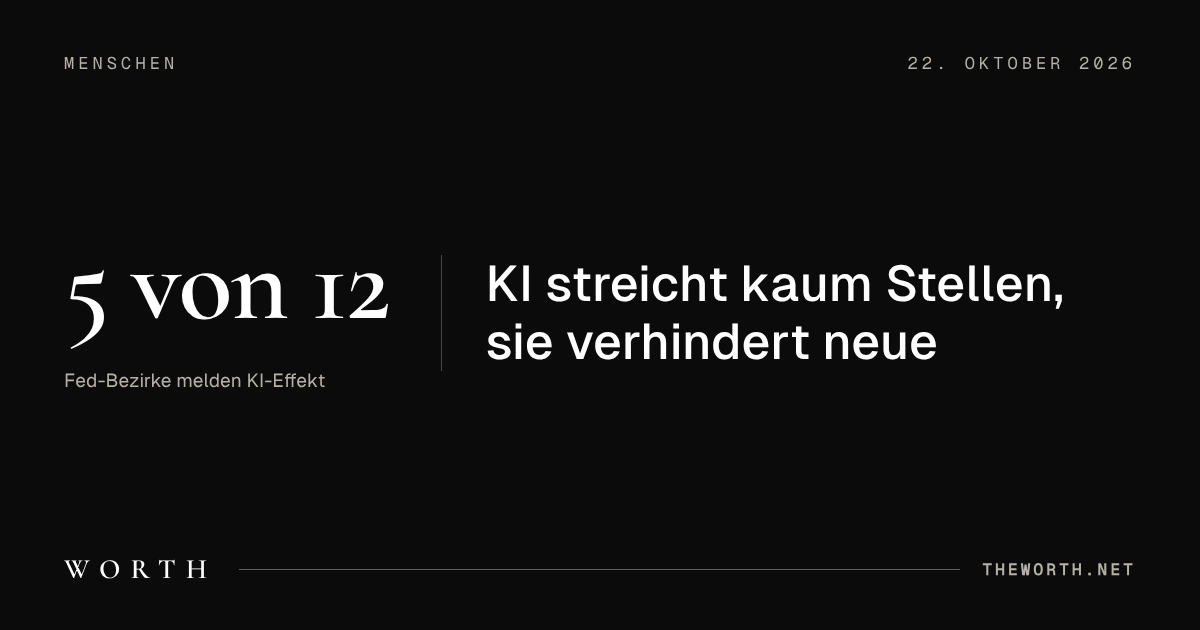
In the Federal Reserve's latest Beige Book, firms in five of twelve districts report that after investing in AI they are shrinking staff through attrition, postponing hires or planning fewer new roles. An IAB study covering 22.3 million full-time employees finds no general slump in Germany, but weaker employment among 20- to 29-year-olds in occupations highly exposed to AI.
What happened
The two sources were produced independently and describe the same mechanism. The Fed districts do not report layoffs; they report positions left unfilled or never created. IT staffing firms in the Minneapolis district say AI is not causing dismissals but is damping the creation of new jobs. Banks in the Cleveland district report lower headcount needs as roles become more productive.
The IAB reaches a more cautious finding for Germany. Between 2022 and 2025, full-time employment in AI-exposed occupations grew by about 1% overall, while it fell by roughly 3% in less exposed ones. Among 20- to 29-year-olds the picture reverses: minus 3.8% against minus 2.6%. The gap is not statistically significant but widens over time. The link is significant only in manufacturing and in non-graduate occupations. According to the IAB, the economic slowdown currently weighs about twice as heavily as the AI effect.
What follows
If AI acts first through hiring freezes, the cost falls on those not yet inside the firm: graduates, career changers, returners. Existing workforces stay largely protected, which keeps the shift inconspicuous in employment statistics for a long time. For companies this creates a medium-term risk: those who cut entry-level roles today train fewer people for the specialist and leadership positions of the next five to ten years. In Germany this meets a labour market that is shrinking demographically. How much of the decline is really due to AI remains uncertain. The IAB measures only how exposed occupations are to AI in theory, not whether firms actually use it. The authors therefore call for establishment-level data.
What to watch
- Employment of 20- to 29-year-olds in manufacturing and non-graduate occupations in the next IAB and Federal Employment Agency data
- Number of Fed districts citing AI as a reason for restraint in hiring in the next Beige Book
- Apprenticeship and trainee intakes announced by large employers for 2027
Sources
- Federal Reserve: Beige Book, Oktober 2026
- IAB-Forum: KI als Jobkiller für Berufseinsteiger? Entwarnung mit Vorbehalt
- IAB-Presseinformation: KI bisher kein Jobkiller, aber Berufseinsteiger zunehmend betroffen